- DATE:
- AUTHOR:
- The Avidon Health team
Habit Builders Can Go Again, Sharper Charts, and Updated Content
This release is all about momentum. Members can now retake Habit Builders, so a program that works can keep working, incentives included. The Challenges Dashboard shows how participants move through fixed-start challenges week by week and phase by phase. Our annual content review brings the library in line with the latest clinical guidelines, and November’s Autopilot Challenge, Seasonal Balance, arrives just in time for the busiest stretch of the year.
Habit Builders Open for Retaking
Good habits stick stronger the more they're practiced, and Habit Builders can now be individually set to enable retaking. For clients who pay incentives on Habit Builders, that means one program can support round after round of participation.
What’s New
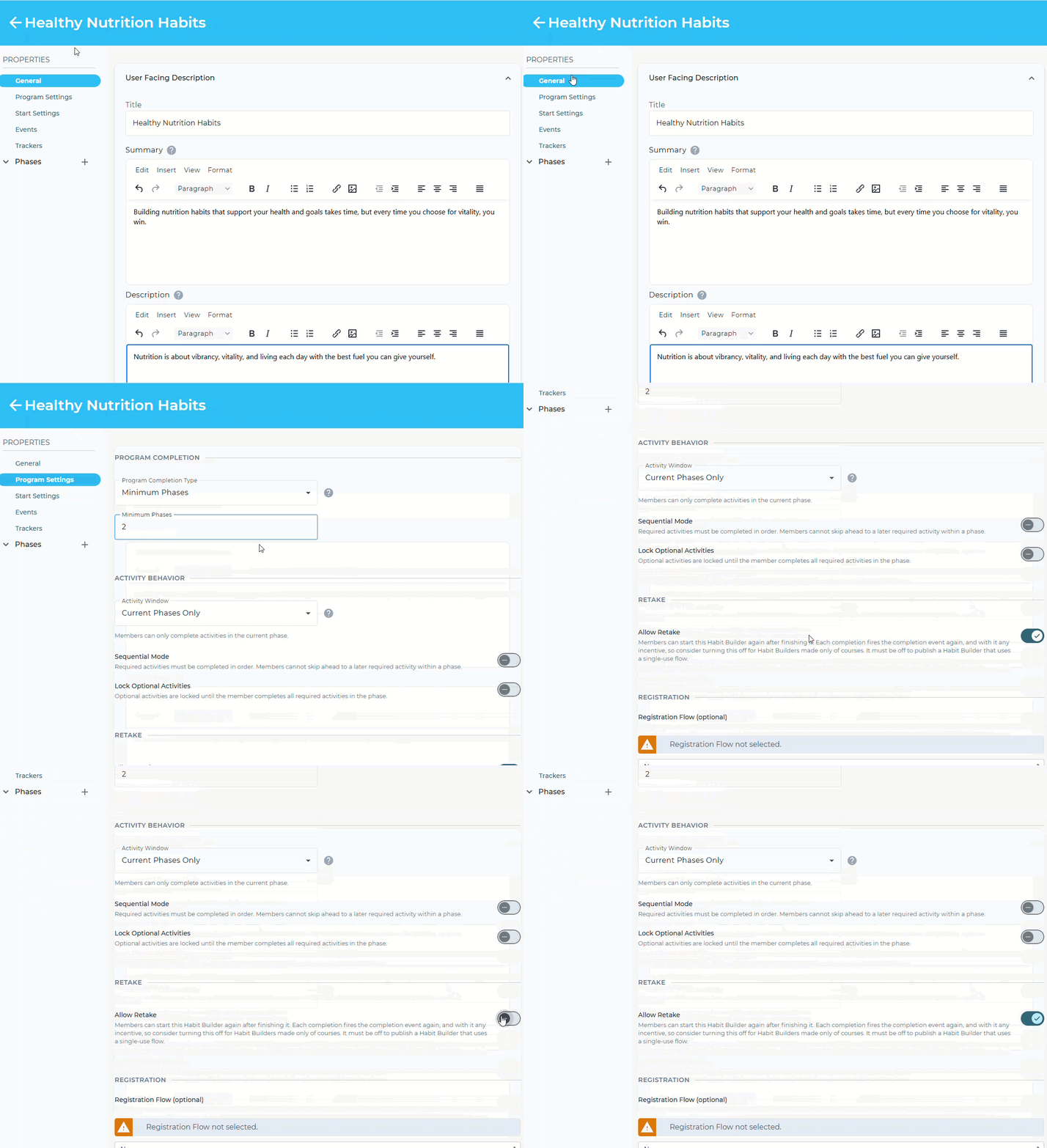
An “Allow Retake” Setting for Every Habit Builder
Every Habit Builder now has an Allow Retake setting in the admin. It’s on by default for new and existing Habit Builders, so retakes are available across the full catalog on release day. Want a Habit Builder to stay one-and-done? Turn the setting off for that Habit Builder.
Retake Right Away
There’s no cooldown and no plan-year restriction; members can start again as soon as an attempt wraps up.
A Way Back in for Fixed-Progression Habit Builders
Fixed-progression Habit Builders release phases on a set schedule within a set window, so everyone moves at the same pace. When that window closes before a member finishes, they can now start the Habit Builder again, even though they never completed it.
A Clean Slate for Automations
When a member retakes a Habit Builder, any scheduled or in-progress automations from the previous attempt that were triggered by registration or phase completion are canceled. The new attempt starts everything fresh, so nobody gets a nudge meant for their first round halfway through their second.
One Exception: Single-Use Flows
Retake isn’t available for Habit Builders that include a single-use flow activity. If you try to combine the two, the flow editor shows a warning.
Why It Matters, in a Nutshell
Incentive Programs with Staying Power—Offer members another round of an incentivized Habit Builder without rebuilding or duplicating content.
Control Where You Want It—Allow retakes on some Habit Builders and keep others one-and-done.
Fewer Dead Ends for Members—Members whose Fixed window closed before they finished get a path back in.
Challenge Reports, Charted Phase by Phase
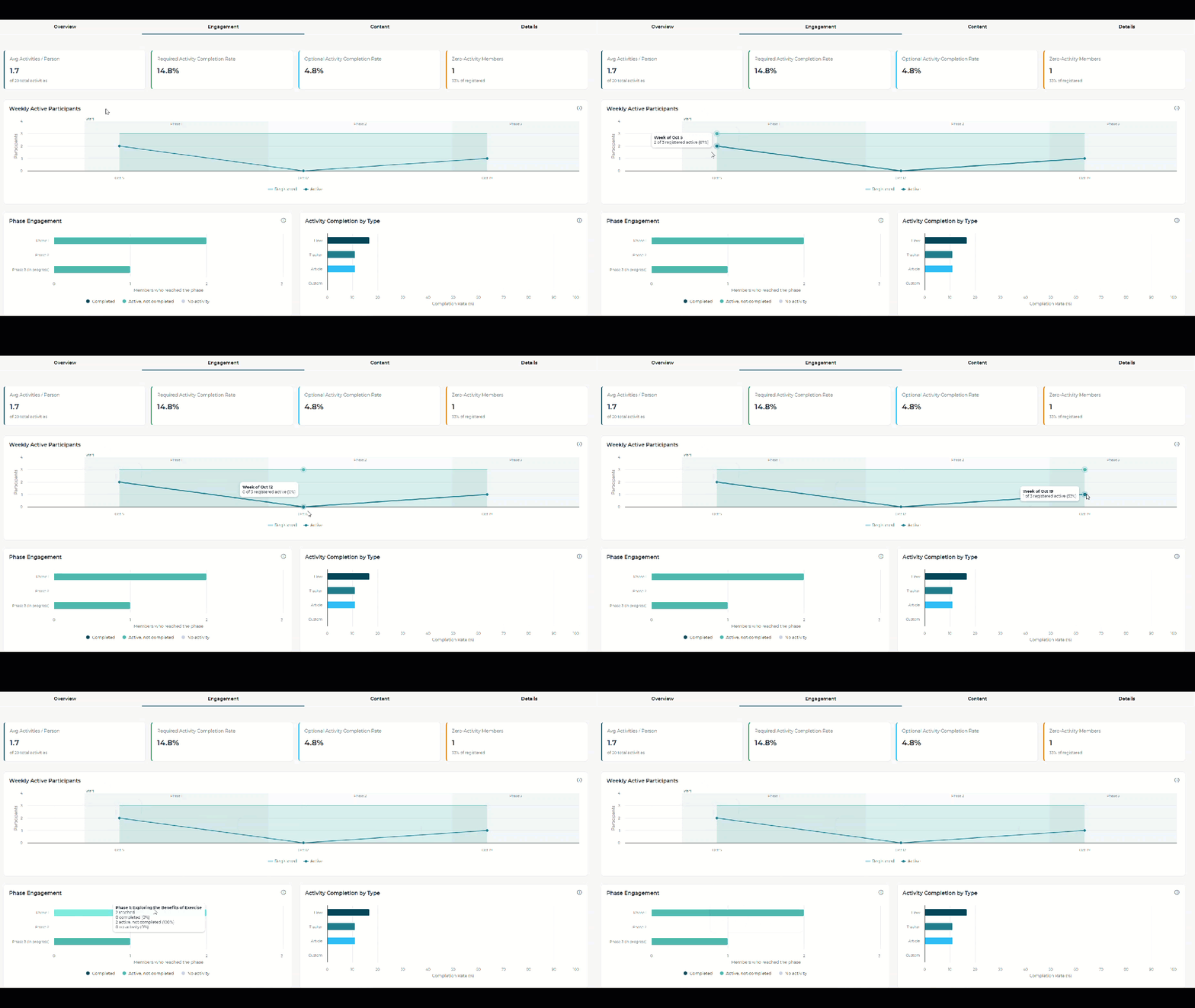
The Challenges Dashboard’s Engagement tab now gives a sharper view of how participants move through fixed-start challenges, where everyone begins on the same date and moves through each phase on the same schedule. The Weekly Active Participants chart now shows registration growth and phase timing alongside weekly activity. A new Phase Engagement chart shows what participants do inside each phase. Both charts apply to fixed-start Challenges.
Updated: Weekly Active Participants
The chart runs week by week (Monday to Sunday), from the registration start date through the end of the challenge, including any grace period. For a challenge that’s still running, the chart shows weeks up to the current one. Every week in that range appears, so a quiet week shows as zero instead of disappearing.

The chart now includes:
Registered so far—Background shading shows cumulative registrations, so you can watch sign-ups climb and level off when registration closes.
Active participants—A line tracks the distinct participants who completed at least one activity that week.
Phase bands—Each phase appears as a labeled background band, with a marker where the challenge starts, so weekly activity lines up with the phase participants were in.
Clearer tooltips—Hover over a week to see a plain-language readout, like “Week of Jan 5 · 42 of 60 registered active (70%).”
The Completing series has been retired; phase completion now has its own chart, since phases can run 1, 7, or 14 days and don’t line up with calendar weeks.
New: Phase Engagement
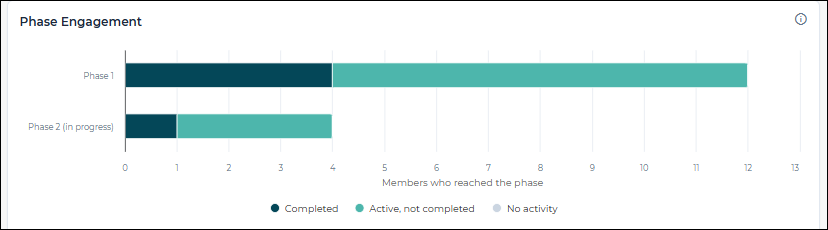
Phase Engagement shows a stacked bar for each phase, made up of the participants who reached it, split three ways:
Completed the phase—The member’s phase completion is recorded, matching what members see on their own screens.
Active in the phase—The member completed at least one activity in the phase but didn’t complete the phase.
No activity—The member reached the phase but didn’t complete any activities in it.
Hover over a bar for the full breakdown, like “Phase 2: Building Habits · 120 reached · 64 completed (53%) · 31 active (26%) · 25 no activity (21%).”
The phase that’s currently running is marked as in progress, so participants who still have time to finish don’t drag down the numbers. Phases that haven’t started yet stay off the chart, the same way the Retention Insight chart handles them.
Phase Engagement and Retention Insight work as a pair. Retention Insight shows whether people move from one phase to the next. Phase Engagement shows what they do while they’re in each phase.
Why It Matters, in a Nutshell
Numbers You Can Take to Leadership—Weekly engagement reads as a percentage of registered participants, a number anyone can follow.
See Where Momentum Builds—Phase bands show which parts of a challenge draw people in.
Pinpoint Where People Drop Off—See who finished, who’s mid-phase, and who hasn’t started, so you know where a reminder will help most.
Fair Reads on Live Challenges—In-progress phases are flagged, so no challenge is judged early.
Client-Ready Reporting—Brokers and HR consultants get charts that explain themselves in a client review, with no extra export or footnotes.
Together, these charts show who’s taking part, when, and how far they get, so every fixed-start challenge tells its own story.
The Content Library Gets Its Annual Checkup
Health guidance moves fast, and the past year moved faster than most. It brought a new blood pressure guideline, new Dietary Guidelines for Americans, a Surgeon General advisory on alcohol and cancer, and updated screening recommendations. Our annual content review went through every content category so that what members consume reflects current guidance from the most trusted and authoritative organizations.
What We Checked
Every content category got a look, with a focus on four areas:
Clinical guidelines—Current recommendations the Dietary Guidelines for Americans, the American Diabetes Association, the CDC, and the Surgeon General.
Statistics—Prevalence figures checked against current sources.
Language—Person-first, weight-neutral, and inclusive wording throughout.
Resources and safety—Crisis lines, links, and phone numbers checked and, when necessary, modified.
What’s Updated
Updates landed across the content library, the Alcohol and Easing into Exercise Habit Builders, and the Blood Pressure and Nutrition courses:
Blood pressure—Current category ranges, guidance for readings of 180/120 or higher, medication notes, and how to measure blood pressure at home.
Heart health—Sodium and hydration guidance aligned with current recommendations, including for people with heart failure.
Alcohol—“Less is better” guidance that reflects the Surgeon General’s cancer risk advisory, plus support resources and a withdrawal safety note.
Nutrition—Aligned with the 2025–2030 Dietary Guidelines, including protein guidance for people with kidney disease and refreshed links.
Diabetes—Clearer explanations of type 1, type 2, and insulin, plus safety information on low blood sugar.
Cancer screening—Current colorectal and cervical (Pap and HPV) screening options and intervals, plus colonoscopy safety information.
COVID-19—Emergency warning signs, current isolation guidance, and treatment information.
Everything else—Current physical activity targets, waist measurement, and person-first, inclusive language throughout.
Why It Matters, in a Nutshell
Content That Holds Up to Scrutiny—Guidance lines up with the sources your benefits team and members’ doctors already trust.
One Less Thing to Vet—The review happens every year, so you can recommend content with confidence.
Room for Every Member—Respectful, person-first language helps more members see themselves in the content.
November Autopilot Challenge: Seasonal Balance
Registration opens: October 26 | Challenge begins: November 2
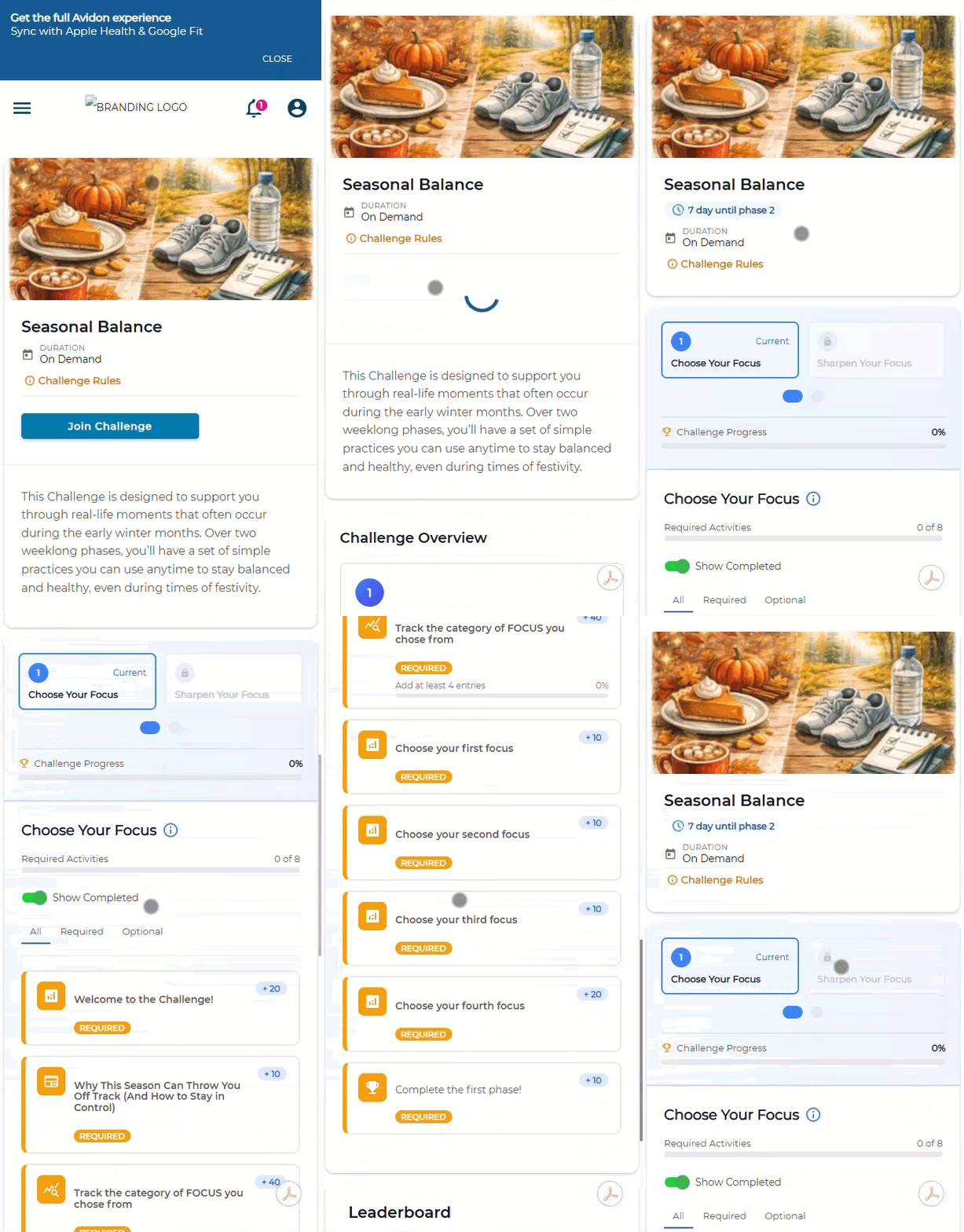
Seasonal Balance is a two-week Challenge built for the stretch of the calendar most likely to knock a routine off course, with more parties, more sugar, less sleep, and a lot less structure. Each day, participants pick one focus (eating, movement, or stress), take one small, specific action inside it, and log it, aiming for at least four days a week. They can switch focus whenever they like. The actions are practical enough to use mid-celebration: deciding on two slices of pizza before the box opens, taking a five-minute walk on a day that would otherwise stay still, or taking three slow breaths before reacting to a stressful moment. Week 1 is about choosing a focus and noticing where the season pulls hardest; Week 2 sharpens that focus, trading in-the-moment reactions for decisions made ahead of time. When a day goes sideways, nobody has to wait until Monday to start over; the next decision is always the one that matters.
Communication is Key
Read the full article in the Product Communication Center, where you can also submit your thoughts and ideas.
If you want to learn more about Avidon Health, please visit our website. Want to reach out to our team of experts? Click here for our helpdesk.